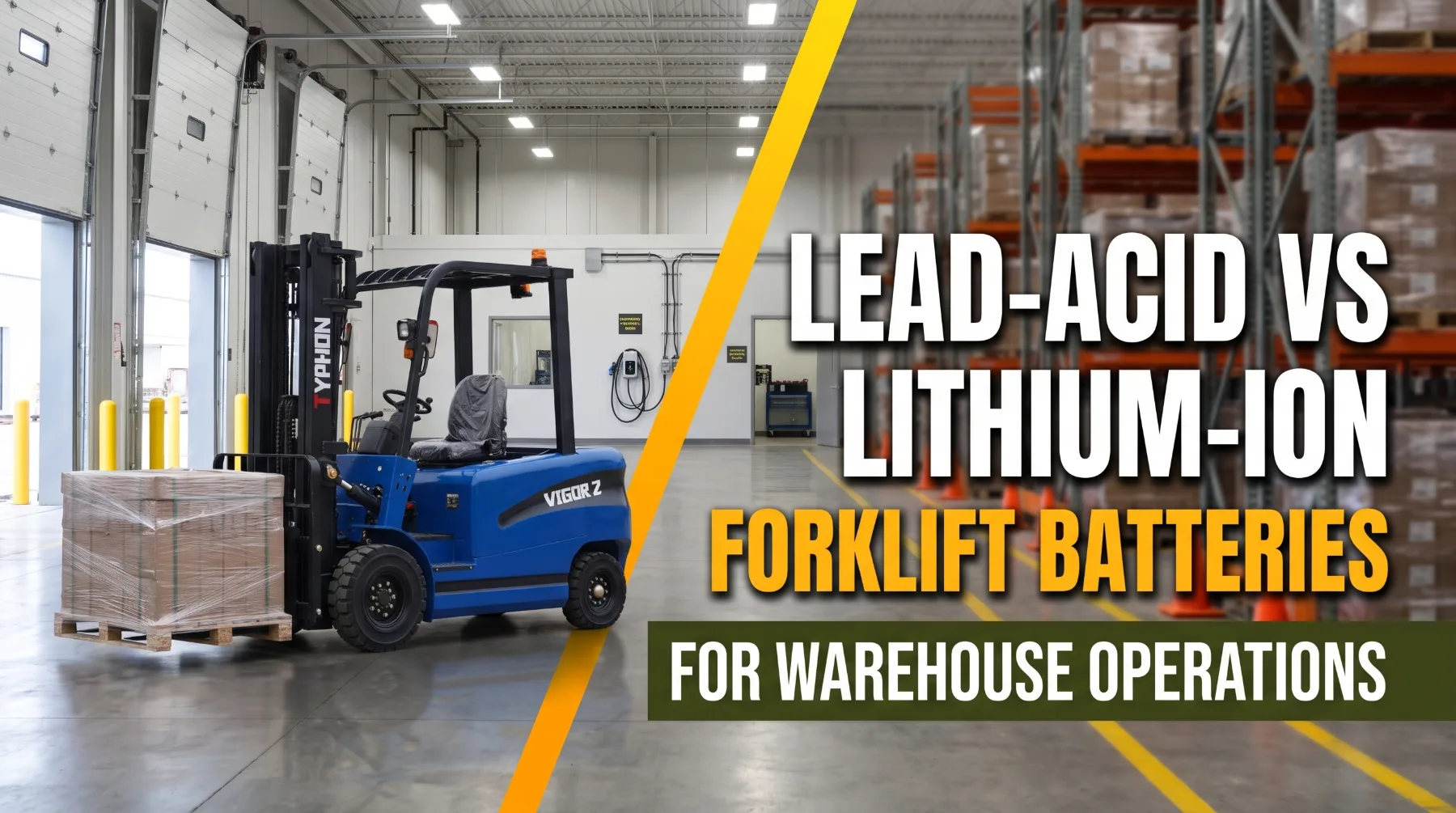
A regional distribution center runs its electric forklift fleet around the clock to keep up with growing e-commerce orders. For years, the operation has relied on lead-acid batteries and a dedicated battery room. At every shift change, operators line up their trucks, a technician swaps the discharged batteries for charged ones with a battery change cart, and the spent batteries go on charge to cool and rest before the next rotation. The process works, but it takes time. On busy days, forklifts wait in line at the battery room, and operators notice their trucks lifting and traveling more slowly as each shift wears on.
When the facility expands, the operations manager studies the alternatives instead of simply adding more batteries and chargers. She pilots lithium-ion batteries on several trucks. Operators plug them in during breaks and lunch, and the trucks keep working through the shift without a battery change. Lift speed stays steady from start to finish, and the watering schedule disappears for those trucks. The pilot also shows that lithium-ion isn't automatically the right answer for every truck in the fleet. Some older forklifts aren't approved for the new batteries, and a few low-use trucks on a single shift run perfectly well on their existing lead-acid systems. The final decision comes from matching each battery type to the way each truck actually works.
Electric forklifts depend on their battery systems to power travel, lifting, and every electrical function on the truck. Lead-acid and lithium-ion are the two most common choices, and each brings different charging characteristics, maintenance requirements, weight considerations, and long-term costs. Warehouse managers and fleet owners should evaluate battery selection based on shift schedules, charging infrastructure, operating hours, forklift compatibility, and total cost of ownership. This article compares both chemistries across the factors that matter most in daily warehouse operations. The forklift manufacturer's operator's manual, the battery and charger documentation, and applicable regulations, including OSHA's powered industrial truck standard, remain the primary reference for every machine and procedure.
Battery Chemistry and Construction
Lead-acid batteries have powered electric forklifts for generations. A typical forklift lead-acid battery consists of many individual cells housed in a heavy steel tray. Each cell contains lead-based positive and negative plates immersed in an electrolyte of sulfuric acid and water. As the battery discharges and recharges, chemical reactions between the plates and the electrolyte store and release electrical energy. Most forklift lead-acid batteries are flooded designs with removable vent caps, which allow technicians to check and top up electrolyte levels. Sealed designs also exist, but they're less common in heavy forklift use.
Lithium-ion batteries use a very different construction. Instead of liquid electrolyte in open cells, they use sealed lithium-based cells grouped into modules and enclosed in a protective case. Many forklift lithium-ion batteries use lithium iron phosphate chemistry, which is valued for its stability and long cycle life. Every lithium-ion pack includes a battery management system. That system monitors cell voltage, temperature, and state of charge, balances the cells, and protects the battery from overcharging, deep discharge, and operating outside safe temperature limits. Many systems also communicate with the forklift and charger.
These construction differences shape almost everything about how each battery behaves in a warehouse. Flooded lead-acid cells release hydrogen and oxygen during charging, so they need ventilated charging areas and regular watering. Lithium-ion packs are sealed and don't release gas during normal operation, but they rely on electronics that must stay in good working order. Lead-acid voltage gradually declines as the battery discharges, which can make trucks feel slower later in the shift. Lithium-ion systems typically hold more consistent voltage through most of their discharge, so lift and travel performance stay steadier.
Neither chemistry is universally better. Lead-acid offers proven technology, wide availability, and a lower purchase price. Lithium-ion offers sealed construction, built-in monitoring, and more flexible charging. Understanding how each is built is the first step toward choosing the right battery for each application.
Key takeaway: Lead-acid batteries use lead plates in liquid electrolyte within open cells, while lithium-ion batteries use sealed cells controlled by a battery management system, and those construction differences drive charging, maintenance, and performance behavior.
Charging Time and Opportunity Charging
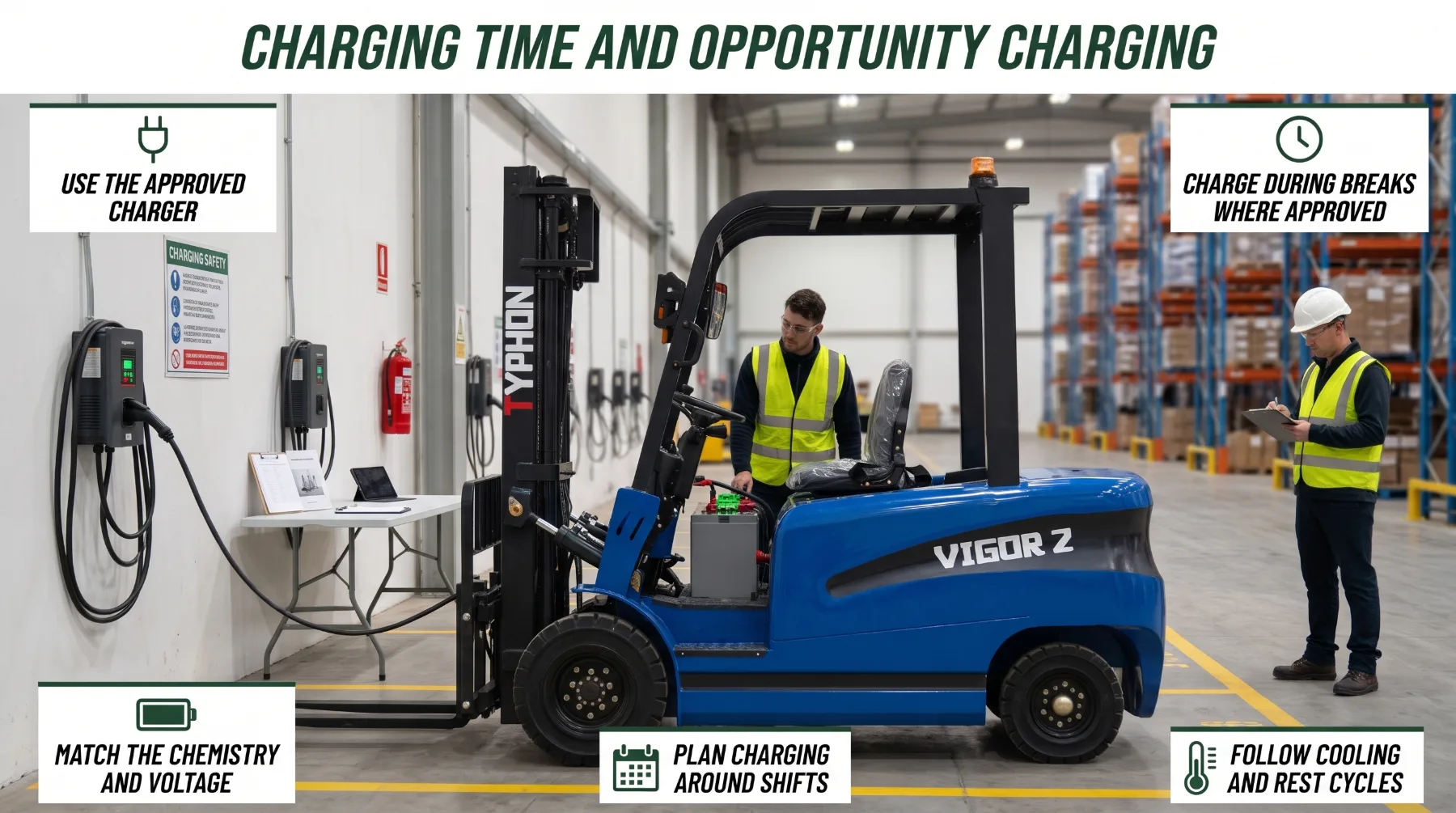
Charging practices often separate the two chemistries more clearly than any other factor. Conventional lead-acid batteries perform best with full, uninterrupted charging cycles. A standard routine involves running the battery through a shift, charging it completely, and then allowing it to cool and rest before returning it to service. That full cycle takes a substantial part of the day. In single-shift operations, the battery can charge overnight with no impact on production. In multi-shift operations, the fleet usually needs spare batteries and a battery room where technicians can exchange discharged batteries for charged ones.
Interrupting lead-acid charging cycles or charging partially discharged batteries frequently can shorten battery life. Lead-acid systems also benefit from periodic equalization charges, which help balance the cells and reduce sulfation. Some operations use fast-charge or opportunity-charge lead-acid systems with specially designed batteries and chargers. Those approaches can reduce battery changes, but they require compatible equipment, careful temperature monitoring, and strict adherence to the manufacturer's guidance.
Lithium-ion batteries are generally designed for opportunity charging. Operators can connect the truck to a charger during breaks, meal periods, and shift changes, adding energy in short sessions without harming the battery. Many lithium-ion systems also recharge considerably faster than conventional lead-acid batteries, and they don't need a cooling period afterward. For multi-shift operations, that flexibility can remove the need for battery changes, spare batteries, and a dedicated battery room. The exact charging approach must still follow the battery and forklift manufacturers' instructions.
Charging time for either chemistry depends on battery capacity, charger output, state of charge when charging begins, battery condition, and temperature. Chargers must match the battery's voltage, chemistry, and charging profile. A charger built for lead-acid batteries can't be assumed safe for a lithium-ion system, and the reverse is also true. Fleet managers should also confirm that the facility's electrical service can support the chargers they plan to install, since faster chargers often require greater electrical capacity and additional charging stations positioned closer to work areas.
Key takeaway: Conventional lead-acid batteries need full charging and cooling cycles, often with battery changes in multi-shift operations, while lithium-ion batteries generally support opportunity charging, so match the charging strategy and charger to the chemistry and shift pattern.
Maintenance and Daily Inspection
Maintenance demands differ widely between the two battery types, and those differences affect labor, facility requirements, and safety planning. Flooded lead-acid batteries need regular watering to replace the water lost during charging. Technicians should check electrolyte levels as the manufacturer directs and add only distilled or approved water. Topping up usually happens after charging, since filling before charging can cause electrolytes to overflow. Lead-acid batteries also need terminal cleaning, removal of acid residue from the battery top, periodic equalization charges, and checks of individual cells when performance drops. Automatic watering systems can reduce labor, but they still require inspection.
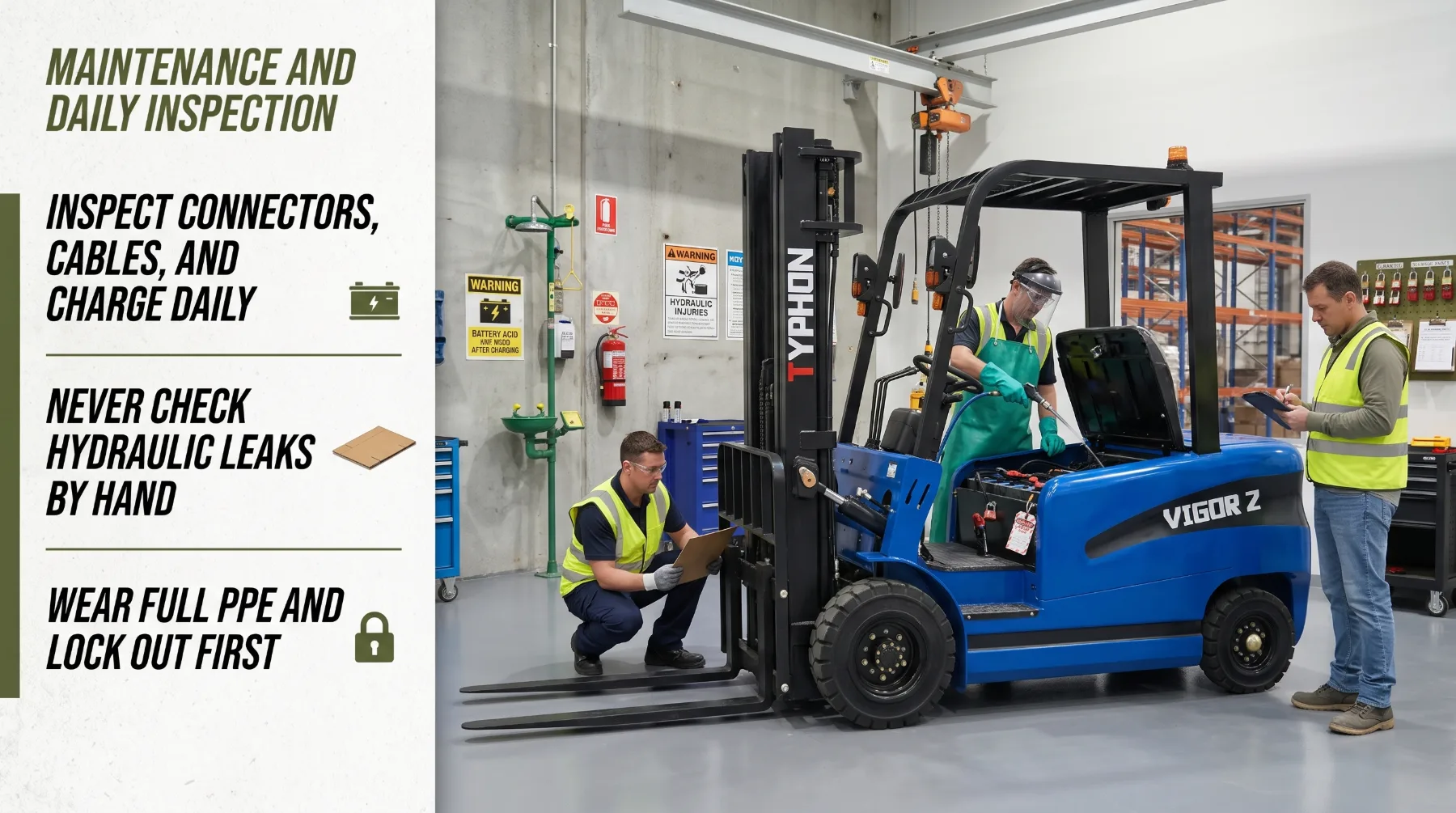
Lithium-ion batteries generally eliminate watering, equalization, and acid cleanup. That doesn't mean they need no attention. Operators and technicians should inspect connectors, cables, and the battery enclosure for damage, confirm that the battery is secured in the truck, and watch the display for battery management system warnings or fault codes. Any sign of swelling, impact damage, unusual heat, or odor requires the truck to be removed from service and assessed by a qualified technician. Never open a lithium-ion battery pack or attempt internal repairs.
Daily inspections apply to every electric forklift, regardless of battery type. Before each shift, operators should check the battery connector and cables for cracks, burns, and loose connections, confirm that the battery restraint is in place, and verify the state of charge on the indicator. They should also inspect the mast, chains, forks, hydraulic hoses, tires, brakes, steering, horn, lights, and seat belt as part of the standard pre-shift check required for powered industrial trucks. The condition of hydraulic systems directly affects lifting performance, mast movement, and the forklift's ability to handle rated loads safely. Report any defect and keep the forklift out of service until it's repaired.
Hydraulic leak checks must be done safely. Never use your hand to search for a hydraulic leak on the mast, tilt cylinders, or hoses. Fluid escaping through a pinhole under pressure can penetrate skin and cause an injection injury. The wound may look minor at first, but it's a medical emergency that requires immediate surgical treatment. Hold a piece of cardboard or wood near the suspected hose, fitting, or cylinder, wear gloves and eye protection, and keep your face and body out of line with the leak point. Maintaining hydraulic pressure, cylinder condition, and hose integrity helps preserve consistent lifting performance and reliable operation over time. If anyone is struck by escaping hydraulic fluid, get emergency medical care at once and tell medical staff it's a hydraulic injection injury.
Battery service also requires proper personal protective equipment. When working with lead-acid batteries, wear acid-resistant gloves, chemical splash goggles, a face shield, and an acid-resistant apron. Keep an eyewash station and suitable flushing facilities nearby, as safety regulations require where battery electrolyte is handled. For both chemistries, use insulated tools and remove rings, watches, and other metal jewelry, since a tool or ring that contacts battery terminals can cause severe burns. Keep sparks, open flames, and smoking away from charging and service areas. Forklift batteries are extremely heavy, so remove or install them only with approved lifting equipment, battery change carts, or spreader beams, and never lift a battery by hand. Leave cell replacement, battery management system faults, and charger repairs to qualified technicians.
Key takeaway: Lead-acid batteries need watering, cleaning, and equalization while lithium-ion batteries need less routine care but close monitoring, and every battery service requires cardboard leak checks, a full lockout, proper protective equipment, and approved lifting methods.
Energy Efficiency and Operating Availability
Energy efficiency describes how much of the electricity drawn from the grid ends up as usable power for the forklift. Some energy is always lost as heat during charging and discharging. Lithium-ion batteries typically convert energy more efficiently than conventional lead-acid batteries, which means less electricity is wasted during each charge. Lead-acid batteries also spend part of every charging cycle on finishing and equalization stages, which consume additional energy. Actual results depend on the battery, charger, operating conditions, and charging practices, so fleet managers should compare measured energy use rather than general claims.
Operating availability often matters even more than energy efficiency. Every minute a forklift spends waiting for a battery change, sitting in a charging line, or running at reduced performance is a minute it isn't moving product. Lead-acid fleets in multi-shift operations lose time to battery exchanges and depend on the battery room running smoothly. Lithium-ion fleets can often stay on the floor longer by charging during natural breaks, which can improve truck availability without adding machines.
Performance consistency also affects productivity. Because lead-acid voltage declines as the battery discharges, trucks may lift and travel more slowly toward the end of a shift. Operators sometimes compensate by working the truck harder or swapping batteries early. Lithium-ion batteries usually maintain steadier voltage, so lift speed and travel speed remain more consistent until the battery approaches its protective cutoff.
The environment plays a role as well. Cold storage and freezer applications reduce available capacity for both chemistries and can affect charging. Some lithium-ion batteries include heating features designed for cold environments, while lead-acid batteries in cold areas may need more frequent charging and careful handling. Heat in charging areas shortens battery life for both types. Whatever the chemistry, follow the manufacturer's temperature limits for operation, charging, and storage.
Key takeaway: Lithium-ion batteries generally offer higher charging efficiency and steadier performance, while lead-acid fleets often lose time to battery changes, so compare measured energy use and real truck availability for your specific operation.
Weight, Compatibility, and Forklift Design
Battery weight plays a structural role in many electric forklifts. On counterbalance trucks in particular, the battery forms part of the counterweight that keeps the forklift stable when it lifts a load. Lead-acid batteries are very heavy, and forklift manufacturers often design trucks around that mass. The forklift's data plate commonly lists the minimum and maximum battery weight approved for the truck, along with battery voltage requirements.
Lithium-ion batteries are usually lighter than lead-acid batteries with comparable energy capacity. That lower weight can be an advantage for handling and floor loading, but it can also create problems in a truck designed for a heavier battery. Installing a lighter battery without proper ballast can reduce the forklift's stability and capacity. For this reason, many lithium-ion forklift batteries intended as replacements include added ballast so their total weight falls within the truck's approved range.
Compatibility goes beyond weight. The replacement battery must match the truck's voltage, fit the battery compartment dimensions, use a compatible connector, and work with the forklift's electrical system and controls. Some lithium-ion batteries communicate with the truck's controller and display, which may require specific integration. Using a battery that the forklift manufacturer hasn't approved can affect performance, safety, and warranty coverage.
Before switching battery types, confirm with the forklift manufacturer or an authorized dealer that the new battery is approved for the truck. Make sure the battery's weight falls within the range on the data plate, and update the data plate if the configuration changes as the manufacturer requires. Have a qualified technician install the battery, secure it with the proper restraints, and verify that the truck's capacity and stability ratings remain valid. Never alter counterweights or battery compartments without the manufacturer's approval.
Key takeaway: Battery weight often serves as part of the forklift's counterweight, so confirm that any battery matches the truck's approved weight range, voltage, dimensions, and connector, and use only manufacturer-approved batteries and installations.
Total Cost Across the Operating Life
Purchase price is only the starting point for comparing forklift batteries. Lead-acid batteries usually cost less upfront, which makes them attractive for operations with tight budgets or light usage. Lithium-ion batteries typically cost more to buy, but they can offer advantages that offset that difference over time. The right comparison considers every cost across the battery's expected service life.
Several factors belong in that calculation. Lithium-ion batteries often last through more charging cycles than lead-acid batteries, which can mean fewer replacements over the life of a forklift. Lead-acid operations may need spare batteries for multi-shift work, battery change equipment, a ventilated battery room, watering systems, eyewash stations, and staff time for watering, cleaning, and exchanges. Lithium-ion operations may need new chargers, upgraded electrical service, and charging stations placed throughout the facility. Energy costs differ because of efficiency, and downtime costs differ because of charging and battery change practices.
Facility space also carries value. A battery room occupies a floor area that could otherwise hold inventory or support operations. Eliminating or shrinking that room can free space in a growing warehouse. On the other hand, a facility with an established, well-run battery room and single-shift operations may see little financial benefit from switching.
End-of-life handling should be part of the plan. Lead-acid batteries have a well-established recycling system, and many suppliers accept used batteries. Lithium-ion recycling continues to develop, and fleet managers should confirm how their supplier handles used batteries. Both types must be stored, transported, and disposed of according to applicable regulations. Warranty terms, service support, and parts availability round out the comparison.
The most reliable approach is to build a cost comparison around your actual operation. Record operating hours, shift patterns, energy use, maintenance labor, battery replacements, and downtime for your current fleet. Then compare those figures with quotes and projections for the alternative. Many operations find that a mixed fleet works best, with lithium-ion batteries on high-use, multi-shift trucks and lead-acid batteries on lighter-duty units.
Key takeaway: Compare purchase price, service life, charging equipment, infrastructure, energy, maintenance labor, downtime, floor space, and end-of-life handling across the battery's full life, and consider a mixed fleet when usage varies.
Conclusion
Lead-acid and lithium-ion forklift batteries each bring real strengths to warehouse operations. Lead-acid batteries offer proven performance, wide availability, and a lower purchase price, and they remain a practical choice for single-shift operations and facilities with established charging routines. Lithium-ion batteries offer sealed construction, opportunity charging, reduced routine maintenance, higher efficiency, and steadier performance, which often suit high-use, multi-shift operations. Weight, compatibility, and the forklift's approved configuration must guide every battery decision, regardless of chemistry.
The best choice comes from matching the battery to the way each truck actually works. Review shift patterns, charging infrastructure, electrical capacity, forklift approvals, and full lifecycle costs before deciding. Then support that choice with consistent daily inspections, approved chargers, safe leak checks, complete lockout before service, and the right protective equipment for battery work. That approach keeps your fleet productive, protects your investment, and helps every operator finish the shift safely.
Frequently Asked Questions
Which forklift battery charges faster?
Lithium-ion batteries often charge faster than conventional lead-acid batteries and don't need a cooling period afterward. They also support opportunity charging during breaks. Actual charging time depends on battery capacity, charger output, state of charge, battery condition, and temperature, so confirm specifications for your exact battery and charger.
Do lead-acid forklift batteries require more maintenance?
Yes, in most cases. Flooded lead-acid batteries need regular watering, terminal cleaning, acid residue removal, and periodic equalization charging. Lithium-ion batteries generally eliminate those tasks but still require inspection of connectors, cables, enclosures, and battery management system warnings. Both types need daily checks and safe service practices.
Can a forklift use either battery type?
Not automatically. The battery must match the forklift's approved weight range, voltage, compartment dimensions, connector, and electrical system. Because the battery often forms part of the counterweight, a lighter battery may require ballast. Confirm approval with the forklift manufacturer or an authorized dealer before switching.
Which battery is better for multiple-shift warehouses?
Lithium-ion batteries often suit multi-shift operations because opportunity charging can eliminate battery changes and spare batteries. Lead-acid batteries can still work well with a properly managed battery room and change process. The best option depends on shift schedules, forklift compatibility, infrastructure, and total lifecycle cost.
SkidSteers.online Featured Equipment
Looking for top-performing heavy equipment, authentic attachments, and dependable jobsite power? Explore verified models backed by manufacturer warranty and nationwide delivery.
View Specifications & Pricing →